By the middle of the year, most yearbook staffs are deep into production and deadlines. Coverage decisions made early can easily go unchecked as the pace picks up. That’s why a mid-year coverage analysis is one of the most valuable checkpoints a staff can build into its workflow.
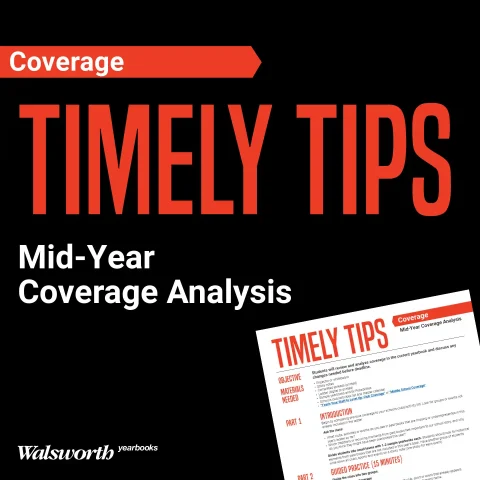
This process, outlined by our latest Timely Tips lesson, gives students the opportunity to step back, evaluate what has already been covered and identify gaps before it becomes too late to fix them. If done well, analyzing your coverage mid-year strengthens storytelling, improves representation and protects the credibility of your yearbook.
What Coverage Analysis Really Means
Coverage analysis goes beyond proofing spreads and writing checklists. It asks students to think critically about who and what the yearbook is representing.
Strong coverage analysis considers:
- Whether all clubs, sports and activities are represented fairly
- If traditions and recurring events are being documented year over year
- How new groups or one-time events are being included
- Whether some groups are receiving too much or too little coverage
This process helps students see the yearbook as a historical record, not just a collection of spreads.
Why Now is the Right Time
Waiting until the final deadline to evaluate coverage leaves little room for meaningful change. A mid-year review gives you the time to adjust ladders, assign additional coverage and rebalance content while spreads are still in progress.
At this point in the year, you should have:
- Completed spreads to review
- A working ladder to revise
- Access to finalized calendars and club rosters
- Enough production experience to recognize patterns and gaps
This makes mid-year the most effective moment for honest evaluation.
Paint the Scene for Your Coverage
One of the most powerful elements of this Timely Tips lesson is the use of sticky notes to visually map coverage.
By labeling page numbers and placing them under each club, sport or event, students can immediately see:
- Which groups appear multiple times
- Which appear only once
- Which are missing entirely
Color-coding planned coverage versus completed coverage adds another layer of clarity. This turns an abstract discussion into a concrete, student-led discovery.
If your staff struggles with club or activity representation, pairing this lesson with Teach Your Staff to Level Up: Club Coverage or Middle School Coverage can help reinforce expectations and strategies.
From Observation to Action
The goal of coverage analysis is not to critique for the sake of critique. It is about making informed decisions.
Once gaps are identified, student leaders should:
- Update the master ladder
- Assign additional coverage where needed
- Adjust page flow to reduce overcoverage
- Plan coverage for upcoming events on the school calendar
This reinforces accountability and shows students that analysis leads directly to action.
Turning Analysis into Better Coverage
Coverage decisions shape how your school is remembered. Taking time to analyze and adjust those decisions mid-year leads to a more accurate, inclusive and intentional yearbook.
The Mid-Year Coverage Analysis Timely Tips lesson plan provides a structured, student-centered way to do just that, taking tools your staff already has to encourage conversations they need to be having.
If you are looking for additional support, examples or guidance on coverage planning, your Walsworth team is here to help.
👉 Reach out to us to see how we can help elevate your coverage.